Brihat Parashara Hora | Jaimini Updesa Sutras
Srimad Bhagavatam
yam brahma varunendra-rudra-marutah scunvancidivyaih scavair
vedaih sanga -pada-kramopanisadair gayani yam sama -gah
dhyanavasthita-tad-gatena manasa pasyanci yam yogino
yasyancam na viduh surasura-gana devaya tasmai namah
Unto that personality whom Brahma, Varuna, lndra, Rudra and the Maruts praise by chanting transcendental hymns and reciting the Vedas with all their corollaries, pada-kramas and Upanisads, to whom the chanters of the Sama Veda always sing, whom the perfected yogis see within their minds after fixing themselves in trance and absorbing themselves within Him, and whose limit can never be found by any demigod or demon—unto that Supreme Personality of Godhead I offer my obeisance’s.
Upadeśam Vyākhyāsyāmaḥ
I shall tell in full the exposition of the teaching/formula/initiatory technique
Abhipasyanti rkśāni pārsvabhe ca
In front are seeing the Rasis and at the side Rasi, both
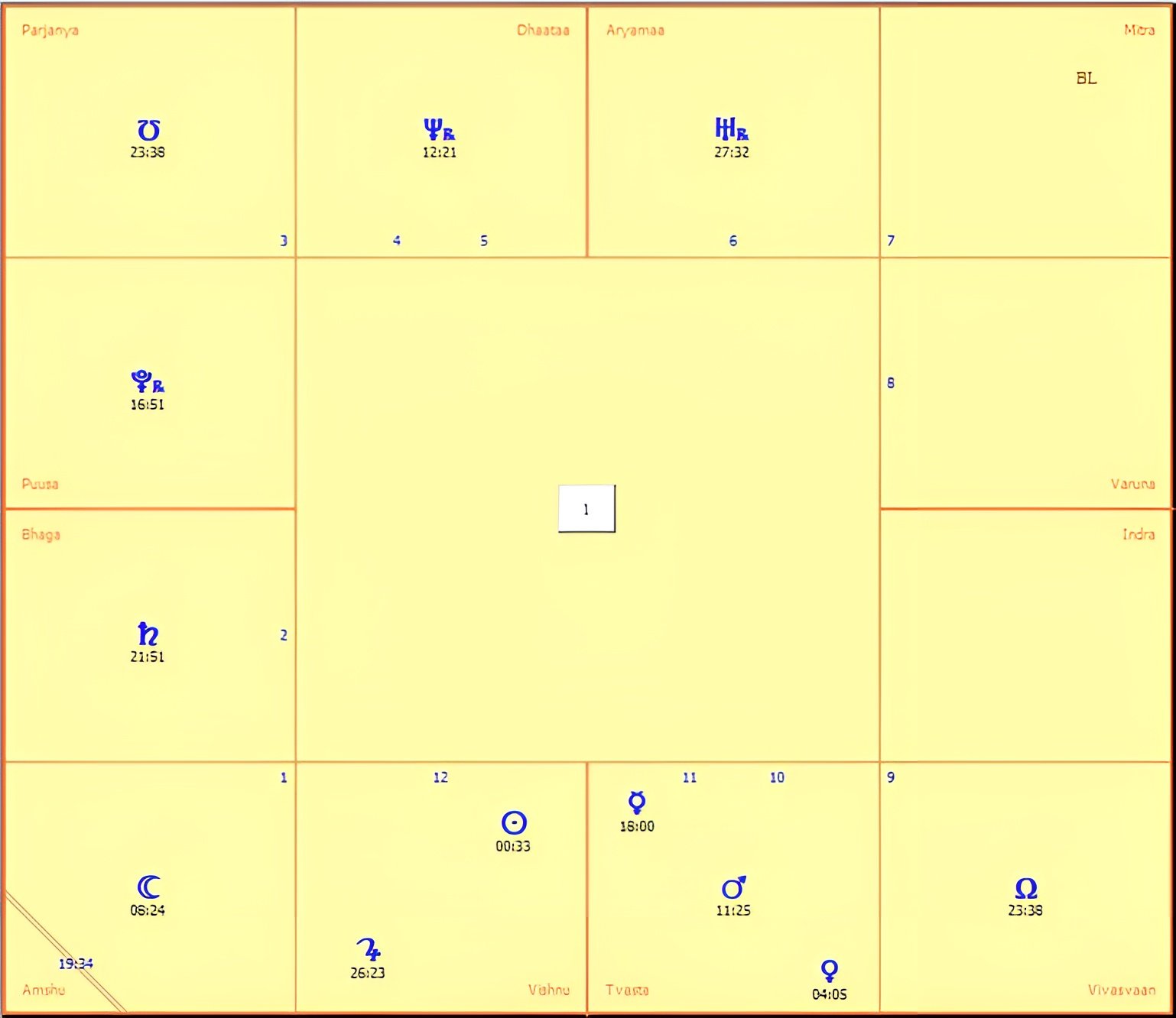
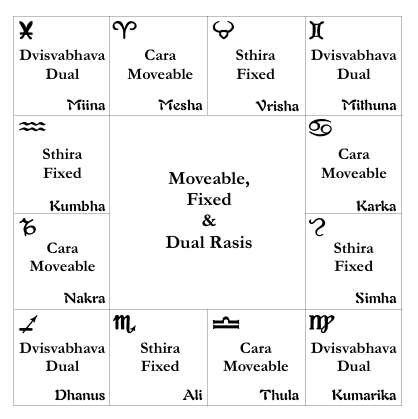
A moveable Rasi aspects the fixed Rasis, except the fixed Rasi right next to it. Dhaata aspects Indra, Vishnu, and Puusa. Varuna aspects Vishnu, Puusa, and Aryamaa. Tvasta aspects Puusa, Aryamaa, and Indra. Bhaga aspects Aryamaa, Indra, and Vishnu.
A fixed Rasi aspects the movable Rasis except the movable Rasi right next to it. Aryamaa aspects Bhaga,Tvasta, and Varuna. Indra aspects Dhaata, Bhaga, and Tvasta. Vishnu aspects Varuna, Dhaata, and Bhaga. Pusaa aspects Tvasta, Varuna and Dhaata.
A dual Rasi aspects the other dual Rasis. Mitra aspectsVivasvaan, Amshu, and Parjanya.Vivasvaan aspects Mitra, Parjanya and Amshu. Amshu aspects Parjanya, Mitra, and Vivasvaan. Parjanya aspects Amshu, Vivasvaan and Mitra.
Purport:
Despite the inherent complexity of the Upadesa Sutras, the system of Rasi Drishti stands as a rare point of universal consensus among astrologers. From classical commentators like Nilakantha to modern practitioners, the interpretation of these particular Sutras remains remarkably consistent. This lack of controversy suggests that Rasi aspects are a foundational component of astrological praxis, rather than an obscure sub-technique.
The structural priority of Rasi aspects in the Brihat Parashara Hora Sastra (BPHS)—where they are defined prior to the introduction of Yogas and long before Graha Drishti (planetary aspects)—implies that sign-based aspects have a much broader application than many modern researchers assume. They represent the primary environmental framework through which planetary energies are filtered.
The mechanics of Rasi Drishti can be understood through the metaphysical principles of the One, the Two, and the Synthesis:
Movable Signs (The One): Representing the creative impulse, initiative, and the positive/active principle.
Fixed Signs (The Two): Representing the receptive reflection, stability, and the negative/passive principle.
Dual Signs (The Synthesis): Containing the attributes of both One and Two, acting as a bridge between the active and reflective states.
Energy flows naturally from positive to negative, or from the initiator to the receiver. Therefore, Movable signs (Active) aspect Fixed signs (Receptive), and vice versa. Dual signs, embodying both polarities, maintain a closed-circuit dialogue with one another. While other techniques of astrology emphasize elemental polarity (Fire, Earth, Air, Water), Rasi Drishti prioritizes the modality (Chara, Sthira, Dwisvabhava) as the primary driver of aspectual energy.
Because Fixed signs are reflections of the Movable signs, they possess a high degree of inertia.
Fixed Signs as Recipients: Each Fixed sign is aspected by three distinct Movable signs. This implies that for a condition in a Fixed sign to undergo transformation, energy must be mobilized across three different "creative" fronts.
Movable Signs as Catalysts: To alter the outcomes of Bhavas (houses) or planets situated in Fixed signs, the practitioner must first address the planets and houses within the aspecting Movable signs.
This suggests a causal hierarchy: changes in the "Movable" areas of life are the necessary precursors to changes in the "Fixed" or stable areas. A shift in a Movable Rasi will invariably trigger a ripple effect in its corresponding Fixed reflection.
1.1.4-9 Argala
1.1.4. dārabhāgyasūlasthārgalā nidhyātuh.
Those standing in the 4th, 2nd and 11th places one ought to consider Argalas
1.1.6b. ripphanīcakāmasthā virodhinah.
Obstructers are those standing in the 10th, 12th and 3rd places.
1.1.8. prāgvattrikone.
As before, more so, at the trine.
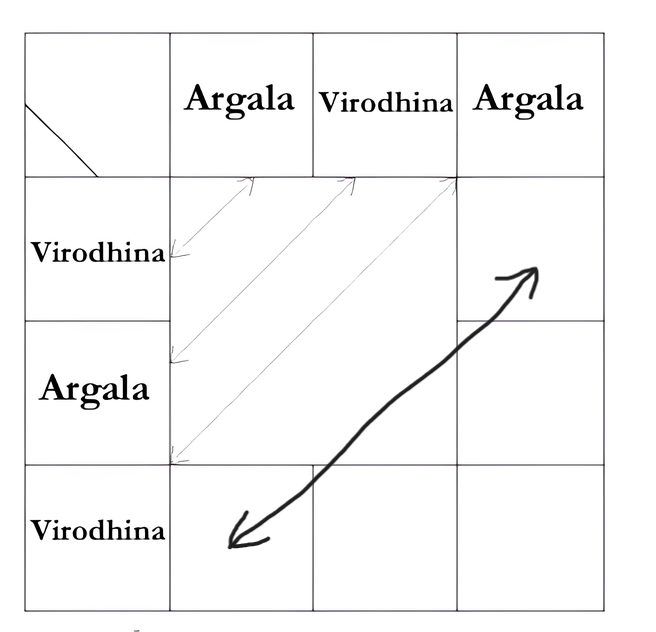
Purport:
In the Upadesa Sutras, the author introduces Argala, the secondary most critical interaction between planets (Grahas) and houses (Bhavas) after sign-based aspects (Rasi Drishti). Argala refers to a "bolt" or "fastener" used to secure a door or lid. It represents a planetary configuration that "bolts down" or stabilizes the destiny associated with a specific house. For a house, planet, or other point to manifest significantly in an individual's life, it must receive Argala. Without this intervention, even the most auspicious planetary combinations such as yogas may fail to yield their promised results in Dasha. If the formative planets of a Yoga do not establish Argala upon the Ascendant or relevant houses, their influence remains latent rather than manifest. The logic of Argala can be understood through the metaphorical "stride" of planetary energy starting from a reference point (e.g., the Lagna):
The Primary Steps: The first step reaches the 2nd house, followed by a second step into the 11th house, and a third step into the 4th house.
The Growth Principle: Each of these positions (2nd, 11th, and 4th) acts as a catalyst, driving the evolution and maturation of the reference house.
A unique exception occurs in the 3rd house. While usually neutral, the presence of malefic planets (Papa Grahas) in the 3rd—particularly when they outnumber or outweigh benefics—creates a specific form of intervention. Though technically in a position of obstruction, these malefics provide the "drive" necessary for the primary house to flourish, a phenomenon Brihat Parashara Hora Shastra identifies as Vipareet (Reverse) Argala.
Just as certain positions foster growth, others act as counter-forces. This is known as Virodhina (obstruction). The Virodhina places are diametrically aligned with the Argala places, effectively "neutralizing" the forward motion: Argala Position — 2nd House, 12th House, 11th House | Virodhina Position — 3rd House, 4th House, 10th House
The obstruction of an Argala is not absolute; it depends on the relative strength of the planets involved. According to the Upadesa Sutras, Virodhina only successfully nullifies Argala if the obstructing planets are more numerous or possess greater inherent strength. To resolve these conflicts, Jaimini provides the First Source of Strength, which utilizes a hierarchical tier system to determine which house (the Argala or Virodhina) prevails:
Count of Karakas: The house containing more "embodied" planets (Sun through Saturn) is considered stronger. Notably, Rahu and Ketu are excluded from this specific count.
Dignity: If the counts are equal, the dignity (exaltation, own sign, etc.) of the planets is assessed.
Modality: If dignities are equal, dual signs are deemed stronger than fixed signs, which are stronger than movable signs.
Planetary Longitude: As a final measure, the degrees (Vargas) of the respective sign lords are compared.
A point of scholarly debate exists regarding Argala from the trines (Trikonas). While many commentators, influenced by later versions of Parashara, suggest the 5th house forms Argala and the 9th forms Virodhina, a strictly logical analysis of Jaimini’s sequential motion suggests the inverse: the 9th house acts as the Argala and the 5th house as the Virodhina.
The calculation of Argala must be reversed when counting from Ketu. This reversal is particularly significant for natives with Ketu in the Lagna or the 7th house, often resulting in highly unconventional lives or fundamental shifts in destiny depending on the resulting planetary "bolts."
Refer to my Jaimini course/playlist on Youtube for further inquiries. Link below.

Collaboration | Contact
Interested in working together? Fill out your info and I will be in touch shortly.